Publications
- Interactive 3D Modeling of Indoor Environments with a Consumer Depth Camera (Demo Video)
Hao Du, Peter Henry, Xiaofeng Ren, Marvin Cheng, Dan B Goldman, Steven M. Seitz and Dieter Fox
- International Conference on Ubiquitous Computing (Ubicomp), 2011 - Binocular Photometric Stereo
(Web Site,
Poster)
Hao Du, Dan B Goldman and Steven M. Seitz - British Machine Vision Conference (BMVC), 2011 - A Prism-based
System for Multispectral Video Acquisition (Web Site, Supplemetal
Material, Slides)
Hao Du, Xin Tong, Xun Cao and Stephen Lin - IEEE International Conference on Computer Vision (ICCV), 2009 - The
Dimensionality of Scene Appearance (Web
Site - linking to the page at GRAIL)
Rahul Garg, Hao Du, Steven M. Seitz and Noah Snavely - IEEE International Conference on Computer Vision (ICCV), 2009 - Correction
of Spatially Varying Image and Video Blur Using a Hybrid Camera
Yu-Wing Tai, Hao Du, Michael S. Brown and Stephen Lin - IEEE Trans. on Pattern Analysis and Machine Intelligence (T-PAMI), June 2010 - Image/Video
Deblurring using a Hybrid Camera (Web
Site - linking to Yu-Wing's site)
Yu-Wing Tai, Hao Du, Michael S. Brown and Stephen Lin - IEEE Conference on Computer Vision and Pattern Recognition (CVPR), 2008 - Relative Epipolar Motion
of Tracked Features for Correspondence in Binocular Stereo (Web Site, Poster, Video Result)
Hao Du, Danping Zou and Yan Qiu Chen - IEEE International Conference on Computer Vision (ICCV), 2007 - Rectified Nearest
Feature Line Segment for Pattern Classification
Hao Du and Yan Qiu Chen - Pattern Recognition, vol. 40, issue 5, pages 1486-1497, May 2007 - Pattern Classification
using Rectified Nearest Feature Line Segment (PPT)
Hao Du and Yan Qiu Chen - Proc. Fussy System and Knowledge Discovery, pt 2, pages 81-90, 2005
Research & Projects
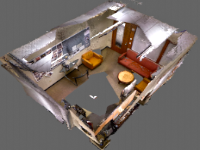
Interactive 3D Modeling of Indoor Environments with a Consumer Depth Camera
We utilize a consumer depth camera to allow non-expert users to scan indoor spaces into 3D models. We build a mobile 3D SLAM system that runs in real-time on a laptop, assisting and interacting with the user on-the-fly. Color and depth info are jointly used to achieve robust 3D registration. This system offers online feedback and hints, tolerates human errors and alignment failures, and helps users to obtain complete scene coverage. (PDF, Demo Video)A Prism-based System for Multispectral Video Acquisition
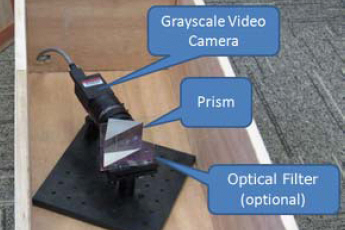
We propose a prism-based system for capturing multispectral videos. Incoming light beams from the scene are sampled by the occlusion mask, dispersed into their constituent spectra by the triangular prism, and then captured by the monochrome camera. Our system is capable of capturing videos of high spectral resolution. We demonstrate the effectiveness of our system with several applications, including human skin detection, physical material recognition, and RGB video generation. (Web Site , PDF, Supplementary Materials)3D Reconstruction with Relative Epipolar Motion
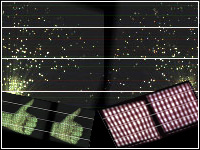
Feature correspondence is a key issue in binocular stereo. The proposed approach matches feature trajectories instead of the features themselves as used by existing methods. It is able to deal with dynamic scenes with indistinguishable features, where challenging cases include, (1) Dynamic 3D scenes with large number of undistinguishable drifting particles; (2) Dynamic surfaces with repetitive textures; (3) Deforming textureless surfaces with actively projected particle-like patterns. (Web Site , PDF, Poster, Video Result)
Pattern Classification using Rectified Nearest Feature Line Segment
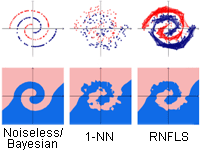
A new pattern classifier termed rectified nearest feature line segment (RNFLS) is proposed. RNFLS enhances the representative capability of the original samples using line-segments conntecting the sample points from the same category, i.e. virtually infinite number of samples along the linear interpolation of the samples from the same class are added and rectified. RNFLS possesses the advantage of concentrating the distribution density, which is viewed as an inverse of the sample-scattering that usually happens in real-world cases. Experiments show that RNFLS significantly outperform 1-NN, k-NN and NFL in most benchmarks. (PDF, PPT)
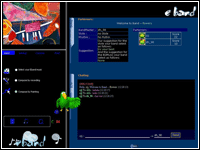
eBand.NET
eBand.NET is an online community for people to compose music together. Tools including humming to music, whistling to music, and painting to music are available. The system merges together the melodies composed by different users. For example, one knocks a table with a pen, and eBand transforms the sound into a type of a chosen drum; another user hums to the microphone, and eBand changes it to a piece of violin melody; also painted notes can be transformed into piano sound. eBand.NET is project made by a team of six, which won the 2nd Place in Microsoft Imagine-Cup 2003 China Final. (Web, VideoDemo)Texture Classification
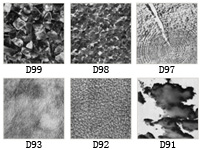
Let the computer recognize & classify textures. This project implemented Chen et al's Statistical Geometrical Features(SGF) method for texture analysis. Each texture image (640px * 640px) is sliced into 4*4=16 pieces. The algorithm is trained and tested using the leave-one-out strategy. Experiment results verify that SGF is robust and is able to achieve 88.68% correct-classification-rate on the entire Brodatz set. Other texture features experimented include Statistical Landscape Features (SLF), and Multiscale Blob Features (MBF). Click to see my experiment results of SGF -> [Go].CPU 32bit RISC
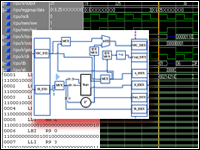
Designed a 32bit RISC CPU with 5-level pipelines using VHDL and implemented it on a Xilinx-FPGA. The FPGA-based CPU supports 18 assembly instructs. The assembler is written in C++. A successful test case was a program computing and printing the prime numbers using a onboard printer. This project covers topics including designing a FPGA-based CPU, designing I/O's with peripherals keyboard, printer, and the procedure of designing and implementing machine instructions and a correpsonding assembly language system. (Web)
3D Display & Depth Sensitivity of Human-Eyes
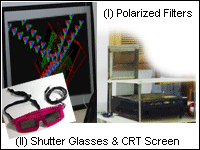
Built a 3D display system using (1) projector pair, polarized filters & glasses; (2) LCD shutter-glasses & 150Hz CRT screen. We captured realworld stereo pictures using calibrated camera pair and also developed stereo animations using OpenGL, and put them onto the 3D display. With the system, we tested the depth-sensitivity of human eyes to scenes that are vertically and horizontally blurred. Experiment findings suggested that it is difficult for human to estimate the scene-depth without clear features, as what happens in computational 3D stereo reconstruction.
Cool Stuff
Fractal Images